
Smart Buildings in Dubai: What Buyers Should Expect in 2026
Key Takeaways
- Al Sa'fat Green Building is now mandatory: From 2026, Dubai Municipality requires the enhanced baseline for all new building permits, forcing developers to integrate measurable energy management systems.
- Building Safety Law No. 3 of 2026 shifts the focus to lifecycle oversight: The regulation emphasises continuous operational accountability over one-off inspections, making integrated monitoring a practical compliance tool rather than a luxury.
- Structural tech matters more than gadgets: Smart buildings in Dubai are moving away from consumer conveniences toward core building management systems (BMS) that protect asset lifespan and lower DEWA bills.
- Capital preservation depends on the right tech: Buyers should prioritise properties where proptech directly reduces service charges and mitigates maintenance liabilities.
Quick Answer
Buyers in 2026 should expect smart buildings in Dubai to feature legally mandated energy efficiency systems, continuous indoor environmental monitoring, and compliance with the Al Sa'fat Green Building standard. Technology is no longer a luxury amenity but a regulatory requirement designed to lower operating costs, ensure building safety, and preserve long-term asset value.
The Regulatory Shift in Smart Real Estate
From marketing feature to permit condition
The narrative around smart buildings in Dubai has permanently changed. In previous years, developers marketed smart-home projects using basic consumer conveniences like voice-activated curtains or connected appliances. In 2026, the market is defined by strict regulatory frameworks and financial prudence.
Smart technology is now embedded into the structural and operational DNA of the building. With Al Sa'fat Green Building established as the mandatory baseline for all new permits, and the introduction of Dubai Building Safety Law No. 3 of 2026, property buyers must look beyond cosmetic tech. The focus is firmly on systems that guarantee compliance, reduce energy consumption, and preserve capital, as set out in the new framework for building quality and safety.
What Defines a Smart Building in 2026
Three systems that do the real work
For investors and end-users, a true smart building integrates technologies that manage resources efficiently and protect the physical asset from degradation.
01
Intelligent HVAC and climate control
Given the extreme climate, cooling accounts for the largest portion of utility costs. Modern smart buildings use predictive HVAC systems integrated with IoT building management networks, monitoring real-time occupancy, external weather and indoor humidity. By maintaining environmental stability, the networks prevent condensation and mould growth, protecting structural integrity and reducing long-term maintenance costs.
02
Predictive maintenance and safety monitoring
Under the new Building Safety Law, property owners are directly accountable for ongoing maintenance across a building's lifecycle. Advanced sensor networks detect abnormal energy consumption, unstable humidity or ventilation underperformance before a mechanical component fails, shifting operations from reactive repair to proactive asset management.
03
Energy and resource optimisation
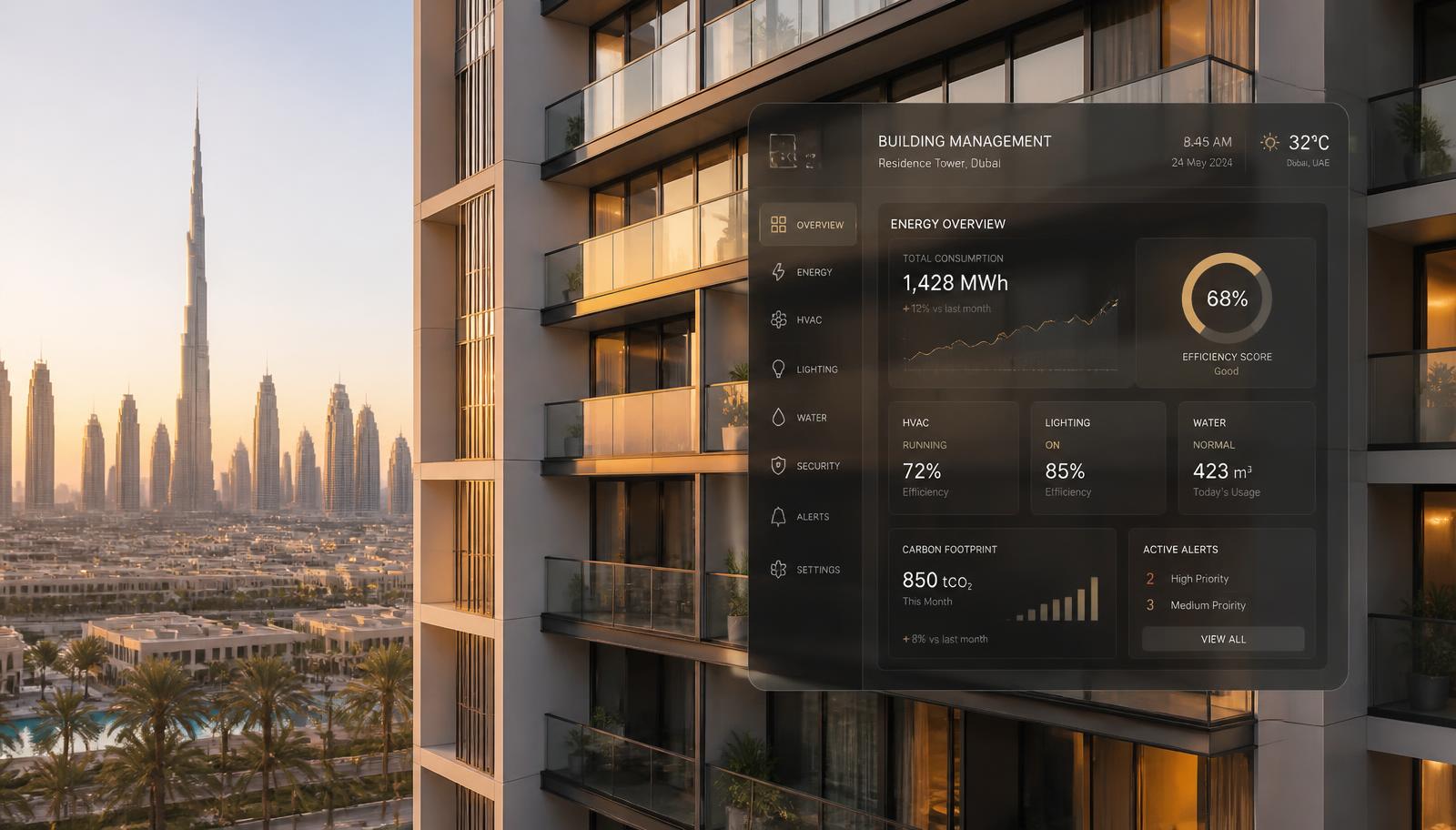
An energy-efficient property in Dubai is now legally required to prove its performance. Smart buildings deliver this through granular energy metering, automated shading linked to solar heat gain coefficients, and intelligent lighting control, with dashboards that track DEWA consumption accurately for yield calculations.
20%
minimum energy reduction above the ASHRAE 90.1 baseline, mandated by Al Sa'fat
40%
of a typical Dubai building's operating cost goes to cooling, the primary target for smart BMS optimisation
Why this reaches your service charges
Lower and more predictable maintenance costs feed straight into the recurring charges covered in what first-time buyers should know about financial risk in Dubai.
Pre-2026 vs. 2026 Smart Building Standards
From voluntary adoption to mandated performance
The evolution of building requirements highlights the shift from voluntary tech adoption to mandated structural performance.
Pre-2026: Al Sa'fat Bronze (basic compliance)
2026 mandated: Al Sa'fat enhanced tier mandatory for all new permits
Pre-2026: Point-in-time periodic inspections
2026 mandated: Continuous lifecycle monitoring and certification
Pre-2026: Reactive utility billing
2026 mandated: Automated baseline performance verification
Pre-2026: General contractor reporting
2026 mandated: Mandatory Sustainable Materials Passport
Financial Prudence for Property Buyers
Recurring costs, not headline features
When evaluating smart building projects, buyers should exercise strict financial discipline. Do not pay a premium for fragmented smart-home devices that will be obsolete in three years. Instead, verify that the building uses vendor-agnostic, open-protocol Building Management Systems.
Do not pay a premium for
- Fragmented consumer smart-home devices
- Closed, single-vendor ecosystems
- Features that will be obsolete within three years
Verify instead
- Vendor-agnostic, open-protocol BMS
- Chiller performance optimisation
- Indoor air quality monitoring and automated lighting
A building that leverages technology to optimise chiller performance, monitor indoor air quality, and automate lighting will consistently command higher rental yields and sustain lower operational costs.
The same capital-preservation logic that governs why overleveraging is the biggest risk in Dubai real estate applies here: recurring costs, not headline features, decide long-term holding power.
Frequently Asked
Questions
What does the Al Sa'fat Green Building mandate mean for property buyers?
It guarantees that any new property permitted in 2026 meets rigorous energy and water efficiency standards, including a 20 percent energy reduction above the ASHRAE 90.1 baseline. Buyers benefit from lower utility costs and a building envelope designed to reject heat efficiently, ensuring long-term operational savings.
How does proptech impact service charges?
By using predictive maintenance and automated energy management, modern proptech reduces unexpected repair costs and optimises communal utility usage. This data-driven efficiency helps stabilise, and in some cases lower, the annual service charges owners pay.
What is the difference between a smart home and a smart building?
A smart home refers to consumer electronics like smart speakers and app-controlled lights within a single unit. A smart building relies on integrated infrastructure, such as a centralised BMS and continuous environmental monitoring, to manage the entire property efficiently and safely.
Will I have access to my property's energy consumption data?
Yes. Modern energy-efficient developments in Dubai provide owners and tenants with integrated digital dashboards. These display real-time DEWA usage, cooling efficiency, and historical consumption data, allowing for precise budget management.
Why is IoT building management important for capital preservation?
IoT systems continuously monitor structural health indicators like humidity, ventilation performance, and equipment vibration. Detecting anomalies early prevents expensive structural damage and helps the property retain its market value over a longer lifecycle.
How can a buyer verify a building's smart credentials before purchase?
Ask for the Al Sa'fat rating certificate, confirm the BMS is vendor-agnostic and open-protocol, and request recent DEWA consumption dashboards. Under Law No. 3 of 2026, you should also check that the building holds a valid Quality and Safety Certificate, which confirms it meets the ongoing inspection and maintenance obligations now required across a building's operational life.