
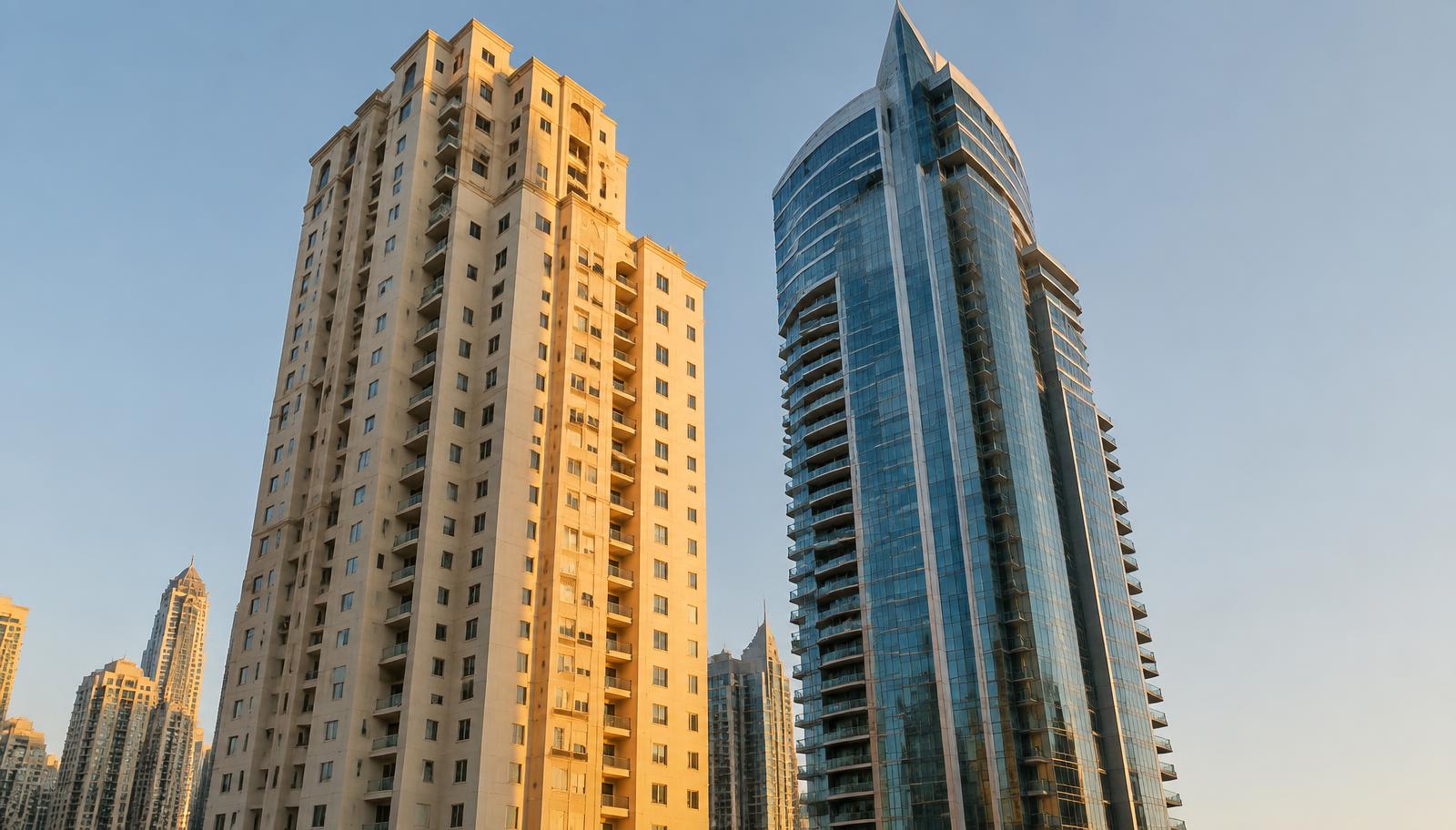
Why Older Buildings in Dubai Trade at a Discount
Key Takeaways
- The building depreciates, the land and location do not: An older Dubai apartment trades below a comparable new build because the structure, systems and finishes lose value with time, while the plot and its location often hold or gain value.
- Service charges quietly reprice the asset: DLD valuations run on net income, not headline rent. Higher service charges and a thin sinking fund pull the valuation of an older unit down before condition is even discussed.
- Regulation now has a clock on it: Under Dubai Building Safety Law No. 3 of 2026, an owner must obtain a Quality and Safety Certificate once a building reaches 20 years from its Completion Certificate, which adds a real compliance cost to aging stock.
- The discount is frequently larger than the true value loss: Because location and floor area survive, an older unit retains replacement value, and selective upgrades can match a new build on net yield. That gap is the opportunity.
Quick Answer
Older buildings in Dubai price at a discount to new builds because of property depreciation on the structure and systems, an aging building technology stack that the market no longer pays for, higher and less predictable service charges, and new compliance obligations that land on buildings as they cross the 20-year mark. Land value and location usually hold, so the discount sits almost entirely on the building itself. For buyers, that means the headline gap between an older and a newer unit often overstates the real loss in value, and a well-chosen older apartment in a prime location can deliver a yield close to a new build once service charges and upgrade costs are counted.
What Counts as an Older Building in Dubai
The discount usually starts around year ten
There is no legal definition of an old building in Dubai. In practice, the market treats stock built roughly between 2002 and 2015 as older, and the discount tends to appear from around the tenth year of a building's life. That is when the first wave of major capital works comes due, when the technology gap against newer towers becomes visible, and when the twenty-year regulatory horizon starts to matter to a buyer planning a hold.
The key point about property depreciation in Dubai is that it applies to the building, not the ground it sits on. A freehold title gives permanent ownership with no expiry. Prime plots in Downtown, Dubai Marina, JBR and the established master communities are effectively fixed in supply, so their land and location value tends to hold or climb. What ages is the concrete, the cladding, the chiller, the lifts and the layout. This is why two units at the same address can carry very different prices based on floor, view, condition and finish, and why the discount on an older tower is really a discount on a depreciating asset wrapped around an appreciating one.
The Five Forces Behind the Older-Building Discount
Age is the label. These are the actual drivers.
01
The building technology gap
Newer developments are built to a different standard. Floor-to-ceiling glazing, open-plan layouts, integrated building management systems and higher energy efficiency are now the market default, and Dubai's 2026 building rules make much of this mandatory. Older stock was built for a different era, with closed kitchens, smaller windows, standalone air conditioning units and no central building management. Buyers price that gap in directly, because it shows up every month on the DEWA and chiller bill.
02
Service charges and the sinking-fund liability
Service charges are where an older building can cost more than a newer one, and where the real risk hides. Charges are collected and audited through the RERA-mandated Mollak system under Law No. 6 of 2026, and every owner association must hold a reserve fund in a separate account for major works. When that fund is thin and a facade seal, chiller plant, fire system or lift replacement falls due, owners face one-off special levies. A newer building carries lower capital risk in its early years.
10 to 50k
typical AED range of a special levy on owners in a building with an underfunded reserve
03
The 20-year Quality and Safety Certificate
Dubai Building Safety Law No. 3 of 2026 moved building oversight from one-off inspections toward lifecycle accountability. The practical trigger for older stock is clear. An owner must obtain a Quality and Safety Certificate once the building reaches 20 years from the issue date of its Completion Certificate. For any tower approaching that age, this is a known, dated compliance obligation that a careful buyer prices in before signing.
04
The green two-tier market and financing
Sustainability has moved from a marketing line to a valuation input. Buildings with strong green ratings attract a premium in demand and, increasingly, dedicated green home finance products from UAE banks tied to high sustainability ratings. The DLD has also explored a Green List to flag sustainable buildings. The result is a slowly widening split between certified newer stock and uncertified older stock.
05
The buyer and tenant preference shift
Demand follows the new default. High-net-worth buyers and relocating professionals increasingly prefer smart-enabled, energy-efficient amenities, which supports both the resale value and the rental performance of newer developments. Older buildings compete on space, location and price instead of specification, and the market discount is simply the price at which the trade becomes attractive.
How Older Apartments Are Actually Priced
Net income drives the numbers, not the headline rent
Understanding the discount means understanding how a DLD valuation is built. For residential property, the default is the sales comparison approach, which pulls recent comparable transactions and adjusts for size, floor, view, condition, age and finish quality. Age and condition are explicit adjustments, so an older, unrenovated unit is marked down against a newer or upgraded comparable by design.
The income approach is where service charges bite. Valuation runs on net operating income, not gross rent, so two units with identical headline rent but different service charges will not carry the same value. The unit with the higher charge is worth less. This is the mechanism most buyers miss, and it is why the smart way to compare an older building against a newer one is not gross yield but net operational efficiency.
Gross yield sells the deal. Net yield is the deal. The difference between the two is where older-building risk lives, and where the discount is justified or overdone.
A simple way to calculate it
Net yield = (Gross rent minus service charges minus a 1.5% CapEx buffer minus maintenance) ÷ total acquisition cost
Run that formula and the picture changes. The table below uses illustrative one-bedroom figures to show how a large gap in entry price and rent can collapse to near parity on net yield.
| Metric | Older building | New build |
|---|---|---|
| Entry price | AED 1.3M | AED 1.75M |
| Annual rent | AED 105,000 | AED 135,000 |
| Service charge band | AED 14 to 22 per sq ft | AED 18 to 30 per sq ft |
| Floor area | Larger, often 20 to 30% more | Smaller, more efficient |
| Net yield (after charges and buffer) | Around 6.5% | Around 6.5% |
Figures are indicative for illustration, not a market average. Always run the net yield formula on the actual Mollak invoice, audited accounts and rent for the specific unit.
When the Discount Is an Opportunity
Buy the location, fix the building
Because location and floor area survive depreciation, the older-building discount often overstates the real loss in value. That gap is the basis of a renovation arbitrage. Buy an older unit at a low price per square foot in a prime, walkable location, spend selectively on the systems and finishes the market rewards, and you can lift the rent toward new-build levels while keeping a lower baseline service charge.
Renovation is where discipline pays. Full apartment remodels range from roughly AED 250,000 to AED 450,000, with lighter updates from AED 40,000 to AED 200,000. Kitchens typically run AED 50,000 to AED 100,000 and bathrooms AED 40,000 to AED 90,000. The highest-return choices are usually the least glamorous.
Spend where it returns
Quartz instead of marble, vinyl or laminate instead of hardwood, refinished cabinetry instead of full replacement. Prioritise the two rooms tenants notice most: kitchen and bathrooms. Hold a 10 to 20% contingency, because older buildings reveal surprises once work starts.
One caveat separates a good older buy from a value trap. Within older stock, the developer and the master community still decide how deep the discount runs and how fast you can exit. Units in established, well-maintained communities preserve value better than comparable stock on fringe developments, so community quality belongs in the arbitrage calculation alongside price. The same principle that governs holding power over market timing applies to older stock: the building you can carry and upgrade beats the cheapest headline price.
Due Diligence Before You Buy an Older Dubai Apartment
Five checks that separate a discount from a liability
01
Read three years of audited service charge accounts
Request them through the seller and cross-check against the Mollak invoice and the RERA service charge index for the building.
02
Verify the reserve fund and the 10-year reserve study
A healthy sinking fund means major works are funded. A thin one means a special levy is coming to you.
03
Check the building's age against the 20-year mark
Confirm the Completion Certificate date and whether a Quality and Safety Certificate under Law No. 3 of 2026 is due or given.
04
Inspect the ageing systems
Chillers, lifts, facade seals and fire systems are the components that trigger the largest capital costs in old towers.
05
Run the net yield, not the gross
Price the unit on net operational efficiency after service charges, a CapEx buffer and any planned renovation, then compare it to the new-build alternative on the same basis.
Frequently Asked
Questions
What is considered an old building in Dubai?
Dubai has no legal definition of an old building, but the market generally treats stock built between roughly 2002 and 2015 as older. The discount tends to appear from around the tenth year of a building's life, when the first wave of major capital works comes due.
Do apartments in Dubai depreciate in value?
The building depreciates, the land does not. Property depreciation in Dubai applies to the structure, systems and finishes, which lose value with age and use. The freehold plot and its location usually hold or gain value, especially in prime, supply-constrained areas, which is why an older-building discount sits mostly on the building itself.
Why are service charges a risk when buying an older apartment?
DLD valuations run on net income, so a unit with high service charges is worth less than an identical unit with lower charges. Older buildings also face major capital works on chillers, lifts and facades. If the reserve fund is underfunded, owners can be hit with one-off special levies that commonly range from AED 10,000 to AED 50,000.
Are older buildings in Dubai a good investment?
Yes, when the discount is larger than the real loss in value. Because location and floor area survive depreciation, an older unit bought below replacement value in a prime area and upgraded selectively can match a new build on net yield. The risk lies in service charges, capital works and compliance costs, so the numbers must be run on net operational efficiency rather than gross yield.
What is the 20-year Quality and Safety Certificate under Law No. 3 of 2026?
Dubai Building Safety Law No. 3 of 2026 requires an owner to obtain a Quality and Safety Certificate once a building reaches 20 years from the issue date of its Completion Certificate. For older stock approaching that age, it is a known compliance obligation and cost that a careful buyer prices into the offer.
Does an older building affect resale value and mortgage options?
Yes. Older, uncertified stock competes in a market that increasingly rewards green-rated, smart-enabled buildings on both Dubai resale value and financing, with some banks offering dedicated green home finance tied to high sustainability ratings. A universal penalty should not be assumed, but the direction adds a headwind to older buildings, which is part of why they trade at a discount.