
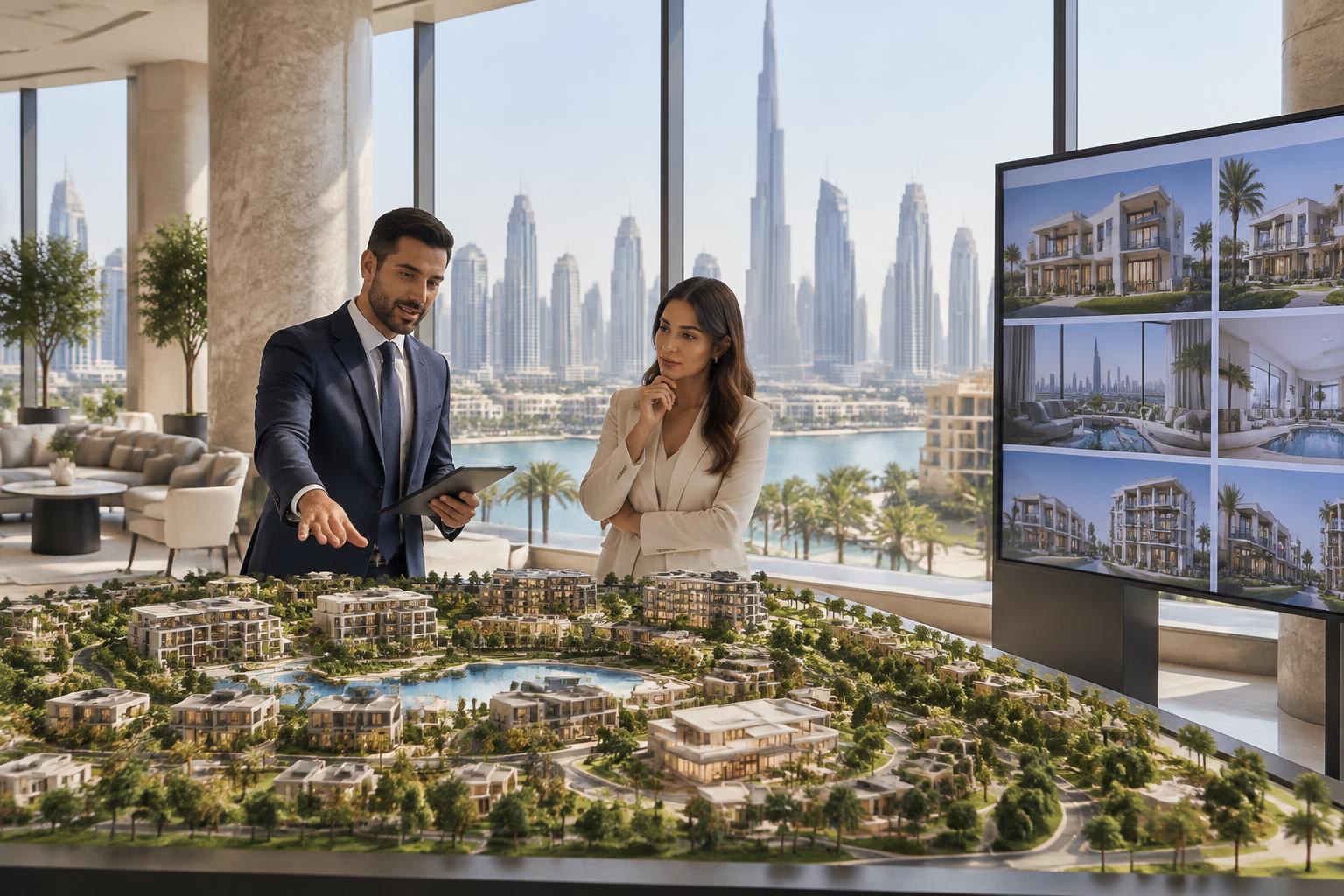
What Separates a Real Estate Developer in Dubai from a Broker: Why Vision Matters
Key Takeaways
- Different jobs, not rivals: A developer creates the property by acquiring land, funding and building a long-term community vision. A broker connects buyers and sellers across many projects for a commission. One builds the landscape, the other helps you navigate it.
- "Agent" and "broker" are the same thing in Dubai: Both work under one RERA license and a Broker Registration Number, operate through a licensed brokerage firm that holds an Office Registration Number, and cannot approach developers independently.
- Buying direct can remove the commission: Purchase straight from the developer and you typically avoid the 2% broker commission plus 5% VAT, leaving the mandatory 4% DLD registration fee as the main transaction cost.
- A broker buys you breadth and objectivity: A developer only sells its own projects. A good broker compares across developers and neighbourhoods and is the right path for the secondary market.
- Vision is the deciding factor: Buy direct when you have chosen a developer and community you believe in. Use a broker when you still need to compare visions before committing.
Quick Answer
In Dubai, a real estate developer and a broker play different roles in a property purchase. A developer conceives, funds and builds a project, selling a long-term community vision directly to buyers, usually off-plan, with payment plans and no brokerage commission. A broker is a licensed intermediary who compares properties across many developers and neighbourhoods and handles secondary market deals for a commission, typically 2% plus 5% VAT. Buying direct from a developer suits a buyer who has already chosen their developer and community and wants to save the commission and access launch incentives.
Working with a broker suits a buyer who needs objective, cross-market comparison or is buying a completed resale property. The right channel depends on whether you are buying into a specific vision or still searching for the right one.
Real Estate Developer vs Broker in Dubai
One builds the landscape, the other helps you navigate it
The clearest way to understand the choice is to understand what they do. They are not competitors selling the same thing. They occupy different points in the life of a property, and the value each adds is different.
A master developer starts years before a buyer appears. They identify prime land, run feasibility studies, secure government permits, arrange funding and manage the full construction timeline. The product is not a single unit, it is a community, and its reputation rests on delivering that vision across an entire development. A broker enters once properties exist. They hold listings across competing developers, track neighbourhood pricing, advise on fit and manage the transaction between a buyer and a seller. The value is breadth, market knowledge and personal service.
Put simply, the real estate developer in Dubai builds the landscape and the broker helps you find your place within it. Neither is better in the abstract. The better choice depends entirely on what you are trying to buy.
The Regulatory Reality in Dubai
What RERA licensing actually means for buyers
Before comparing the two paths, one point clears up most of the confusion buyers carry into the market. In Dubai, "real estate agent" and "real estate broker" are the same thing. They work under the same RERA license, identified by a Broker Registration Number, or BRN, printed on the broker card.
Individual agents cannot operate alone. Each works under a licensed brokerage firm that holds the DLD trade license and an Office Registration Number, or ORN. The agent never deals with the developer directly, the brokerage firm does, and an agent cannot close a deal independently. For a buyer, the practical checks are simple. Verify the BRN of anyone advising you, confirm the brokerage holds a valid ORN, and remember that a developer's own sales team sits outside this structure, because it sells only that developer's projects.
Buying Directly From the Real Estate Developer
Best when you have already chosen the vision
Buying direct means dealing with the developer's own sales team, most often for an off-plan project. The advantages are concrete.
01
No brokerage commission
A direct purchase removes the broker commission, typically 2% of the price plus 5% VAT on secondary deals. On a direct developer sale your main mandatory transaction cost is the 4% DLD registration fee, and developers frequently run promotions that waive even part of that.
02
Launch access and payment plans
Developers reserve their best allocations and incentives for buyers who come to them directly at launch. This is where flexible payment structures live, such as instalments during construction and post-handover plans that spread payment past completion. These terms come from the developer, not a broker.
03
Technical depth and after-sales support
No one knows a building like the company that designed and built it. Buying direct gives you access to construction specifications, the architectural thinking behind the community, material details, and a direct line to after-sales service and maintenance once you have moved in.
The single drawback is the one that matters most to weigh honestly. A developer markets only its own projects. It cannot give you impartial advice on a competing community down the road, because that is not its role. Buying direct assumes you have already decided whose vision you are buying into.
4% + 0%
a direct developer purchase: the mandatory DLD registration fee, and no brokerage commission
Buying Through a Broker
Best when you still need to compare
A broker earns commission by doing the thing a developer structurally cannot, comparing the whole market on your behalf.
01
Breadth across the market
A broker can place properties from different developers, neighbourhoods and asset types side by side, including completed homes on the secondary market that no developer sells. If you do not yet know where or what you want to buy, that comparison is the product.
02
Objective, buyer-aligned guidance
A good broker advises around your financial goals rather than one developer's launch targets, drawing on neighbourhood price trends and live listing data from portals such as Property Finder and Bayut. For the secondary and resale market, a broker is usually the natural channel.
The trade-offs are real too. There is a commission to pay, typically 2% plus 5% VAT where it applies, and incentives can misalign if a broker is steered toward higher-commission listings. The safeguard is the same discipline you would apply anywhere. Confirm the BRN and ORN, ask how the broker is paid, and make sure the advice tracks your goals rather than a particular listing.
Real Estate Developer or Broker: A Side-by-Side View
The same purchase, two channels
Developer direct vs. broker, factor by factor
| Factor | Buying direct from developer | Buying through a broker |
|---|---|---|
| Primary cost | 4% DLD fee, no commission | 4% DLD fee plus 2% commission and 5% VAT where applicable |
| Choice | One developer's projects only | Many developers and neighbourhoods |
| Best for | Off-plan launches, a chosen community | Comparison shopping, the secondary market |
| Payment plans | Developer plans, including post-handover | Depends on the seller and property |
| Advice | Deep but single-developer | Broad and cross-market |
| After-sales | Direct developer service and maintenance | Via the seller or building management |
A developer sells you a vision it has committed years to building. A broker helps you compare visions before you commit. The question is simply which stage you are at.
Which Path Should You Choose?
It comes down to one question about vision
Buy direct from the developer when
- You are targeting an off-plan launch
- You want developer-backed payment plans
- You would rather not pay a commission
- You have chosen the developer or master community you believe in
Choose a broker when
- You want to explore several neighbourhoods
- You need objective comparison across developers
- You are searching the secondary or resale market
- You prefer one point of contact spanning many projects
If you are buying into a specific vision, the people who built it are the right people to buy it from. The same long-term thinking behind holding power over market timing applies to choosing a developer: you are backing a community to mature over years, not chasing a quick entry.
Before you contact anyone
Define three things: your investment timeline, how much independent market guidance you actually need, and the type of property you want. Those three answers point clearly to one channel or the other. And whichever you choose, the same fundamentals still decide the outcome, as covered in what first-time buyers should know about financial risk in Dubai.
Frequently Asked
Questions
Is it cheaper to buy property directly from a developer in Dubai?
Often, yes. Buying directly from a developer removes the broker commission, which is typically 2% of the price plus 5% VAT on secondary deals. On a direct developer purchase your main mandatory cost is the 4% DLD registration fee, and developers frequently offer launch incentives or fee waivers on top. The trade-off is that a developer only sells its own projects, so you give up independent cross-market comparison.
What is the difference between a real estate agent and a broker in Dubai?
In Dubai they are the same thing. Both work under one RERA license identified by a Broker Registration Number, or BRN. There is no separate senior broker qualification. Individual agents must operate under a licensed brokerage firm that holds a trade license and an Office Registration Number, or ORN, and they cannot approach developers or close deals independently.
Can I negotiate directly with a developer without a broker?
Yes. A developer's own sales team sits outside the brokerage structure and sells directly to buyers, most commonly for off-plan projects. This is how buyers access launch allocations, payment plans and promotional incentives without paying a brokerage commission. You still pay the mandatory 4% DLD registration fee.
When should I use a broker instead of buying direct?
Use a broker when you want to compare properties across multiple developers and neighbourhoods, need objective guidance aligned to your goals, are buying in the secondary or resale market, or want a single point of contact across many projects. A broker provides the market breadth and comparison that a single developer, by definition, cannot.
What fees do I pay when buying property in Dubai?
The main mandatory cost is the Dubai Land Department registration fee of 4% of the purchase price. If you buy through a broker on a secondary deal, you also typically pay a commission of 2% plus 5% VAT. Off-plan buyers pay an Oqood registration fee at booking, and additional costs such as trustee and NOC fees can apply depending on the transaction.
Do developers offer better payment plans than brokers?
Payment plans come from the developer, not the broker. On off-plan projects developers offer structured plans, including instalments during construction and post-handover schedules that spread payment past completion. A broker can show you which developers offer which plans, but the terms themselves are set and provided by the developer.