
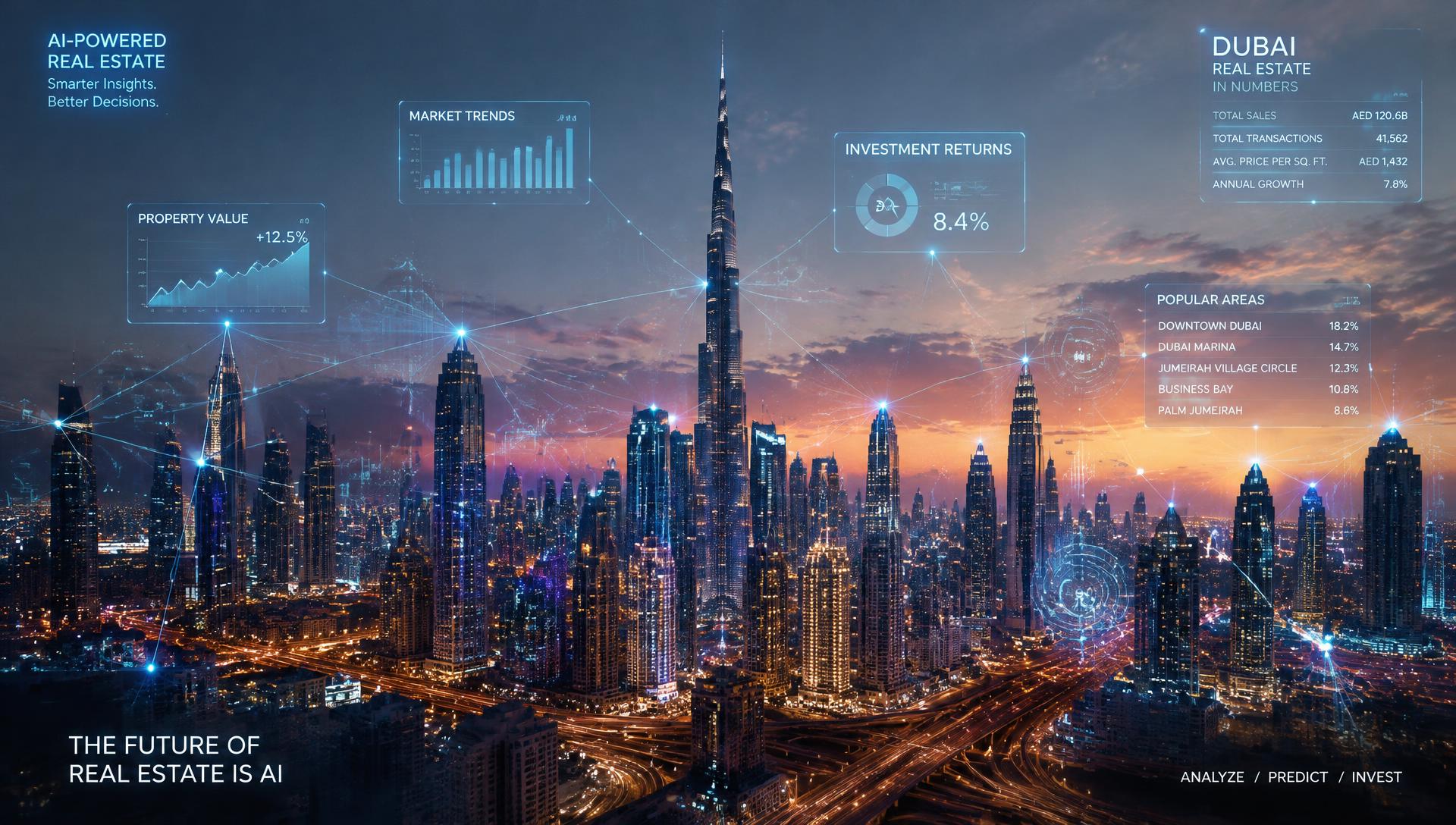
How Technology Is Reshaping Property Value in the UAE
Key Takeaways
- Technology is now infrastructure, not a feature: AI valuation, blockchain tokenization and integrated building systems have moved from marketing novelty to the mechanics that actually set and preserve property value in the UAE.
- Valuation is becoming data-driven: Machine learning models trained on hundreds of thousands of DLD transaction records now predict Dubai prices with high accuracy, and they consistently rank area size, parking, location and registration type as the features that move value most.
- Blockchain is lowering the entry barrier: The Dubai Land Department's tokenization project aims to digitize around 7% of property transactions, worth roughly AED 60 billion, by 2033, letting investors own a fraction of a property rather than the whole asset.
- Smart buildings carry a value and yield premium: Properties with genuine integrated technology are reported to command higher market values and rental yields, mainly because they cut cooling and energy costs in a climate where that is the largest operating expense.
- Ecosystems beat gadgets: The durable premium sits with community-wide integration, energy efficiency and digital title management, not with isolated smart-home devices that date quickly.
Quick Answer
Technology is reshaping property value in the UAE by changing how assets are valued, transacted and operated. Artificial intelligence and machine learning now price properties from large transaction datasets, giving buyers and valuers a faster, more objective read on fair value. Blockchain tokenization is fractionalizing ownership and compressing transaction timelines, widening the pool of investors who can enter the market. Smart building systems lower running costs and support higher rents and resale values, while the Dubai Real Estate Valuation Guide keeps certified human valuers in control of the final number. The result is a market where value increasingly reflects data, efficiency and digital infrastructure rather than location and finish alone.
The Shift to a Data-Driven Real Estate Market
From intuition to infrastructure
Dubai's property market is large enough that small efficiencies matter at scale. Residential and commercial sales reached around AED 326.7 billion in the first half of 2025, part of a wider transaction total that crossed AED 431 billion once mortgages and other registrations are counted. A market moving that much capital rewards any technology that prices assets more accurately, settles deals faster, or lowers the cost of running a building.
That is why PropTech has stopped being a side conversation. Market research projects the UAE PropTech sector to roughly triple to around AED 5.69 billion by 2030, and the direction is backed centrally by the Dubai Real Estate Sector Strategy 2033, which positions the emirate as a digital-first property market. For buyers and investors, the practical takeaway is simple. The factors that set value are becoming measurable, and the market increasingly prices what it can measure.
The Four Technologies Repricing UAE Property
Each one touches a different part of the value equation
01
AI and machine learning in valuation
The clearest change is in how a price is reached. Academic work analysing more than 240,000 Dubai Land Department transaction records has tested a range of machine learning models for predicting apartment prices, with hybrid and support vector approaches delivering the highest accuracy and gradient boosting and random forests proving most robust to noisy, real-world data. The value for a buyer is not the algorithm, it is the output. These models produce a defensible estimate of fair value in seconds and strip emotion out of the first offer. They also reveal what actually drives price, ranking the same top features in a consistent order: area size first, then parking availability, then area name and location, and finally registration type.
02
Blockchain, smart contracts and tokenization
Blockchain changes who can buy and how fast the deal closes. In March 2025 the Dubai Land Department launched the pilot of its Real Estate Tokenisation Project, developed with the Virtual Assets Regulatory Authority and the Dubai Future Foundation. Fractional ownership lets an investor hold a share of a property rather than the whole asset, which lowers the entry barrier and widens the buyer pool for a given building. Smart contracts automate parts of the transfer and settlement process, compressing timelines that once ran into weeks or months toward days, and reducing administrative cost along the way. A deeper, faster, more liquid market tends to support value rather than erode it.
AED 60B
the value of property transactions the DLD aims to tokenize, about 7% of the market, by 2033
03
Smart building systems
Operating cost is where technology meets value most directly. In the UAE climate, cooling is the largest line in a building's running cost, so systems that manage it well protect both the asset and its yield. Integrated smart buildings use predictive cooling, automated energy management and continuous monitoring to cut consumption, and much of this is now set by Al Sa'fat green building rules for new permits. Properties with genuine integrated technology are widely reported to command higher market values and rental yields than comparable conventional stock. A universal premium should not be assumed, and the figure varies by asset and source, but the direction is consistent because the savings are real and recurring.
04
Smart valuation and regulatory oversight
The final piece is governance. The Dubai Real Estate Valuation Guide standardizes appraisal under international valuation standards, and smart valuation uses big data, mapping and automated valuation models to produce estimates at speed. Crucially, the framework keeps a certified human valuer in control of the final number. Automation handles the data, judgment handles the nuance. For buyers and lenders, that combination is what makes a technology-driven valuation trustworthy enough to transact on.
Traditional Versus Technology-Driven Property
Where the value gap opens up
The simplest way to see the shift is to compare the old model against the new one across the parts of a deal that affect value.
| Value lever | Traditional approach | Technology-driven approach |
|---|---|---|
| Valuation | Manual comparables, slower and more subjective | ML models on large DLD datasets, with certified valuer oversight |
| Ownership | Whole asset, high entry cost | Fractional, tokenized shares with a lower entry barrier |
| Transaction speed | Weeks to months | Compressed toward days via smart contracts |
| Operating cost | Reactive maintenance, higher cooling bills | Predictive systems that cut energy and cooling spend |
| Resale and yield | Priced on location and finish | Priced on efficiency and digital infrastructure too |
Technology does not replace the fundamentals of property value. It makes them measurable, and the market is learning to price what it can measure.
What This Means for Investors
Buy the ecosystem, not the gadget
The strategic mistake is to chase isolated features. A voice assistant or a connected doorbell adds little durable value and dates within a few years. What the data rewards sits in the infrastructure layer: community-wide energy efficiency, integrated building management, and clean digital title and transaction records. Those are the elements an AI valuation model, a tenant and a future buyer all reward.
The same discipline that governs holding power over market timing applies here. Technology improves the odds, but it does not remove the need for sound fundamentals.
Prioritise buildings where the technology lowers real operating costs and where the paperwork is clean and digital, then let the data-driven market price that advantage over time.
Smart-property due diligence
Favour open-protocol, vendor-agnostic building systems over closed, single-vendor ecosystems that lock you in. Confirm DEWA integration and real energy dashboards, not just app-controlled lighting. Check who manages the infrastructure, and whether title and transaction records are clean and digital. Weigh the technology by the operating cost it removes, not the features it advertises.
Frequently Asked
Questions
How is technology changing property value in the UAE?
Technology is reshaping UAE property value in three main ways. Artificial intelligence and machine learning price properties from large transaction datasets, blockchain tokenization fractionalizes ownership and speeds up transactions, and smart building systems lower operating costs to support higher rents and resale values. Together they shift value toward data, efficiency and digital infrastructure rather than location and finish alone.
Does AI really value property more accurately than a human?
AI valuation models trained on hundreds of thousands of Dubai Land Department records can predict prices quickly and objectively, and research shows high accuracy for apartment valuations. However, Dubai's valuation framework keeps a certified human valuer in control of the final figure. The practical model is automation for the data and speed, and human judgment for the market nuance and regulatory compliance.
What is real estate tokenization in Dubai?
Real estate tokenization converts property ownership into digital tokens on a blockchain, so an investor can own a fraction of a property rather than the whole asset. The Dubai Land Department launched a pilot of its Real Estate Tokenisation Project in 2025 and aims for tokenized transactions to reach around 7% of the market, roughly AED 60 billion, by 2033. It lowers the entry barrier and broadens the pool of buyers for a given property.
Do smart home features increase a property's value in Dubai?
Integrated smart building technology is widely reported to support higher market values and rental yields, mainly because it reduces cooling and energy costs, which are the largest operating expense in the UAE climate. A universal premium should not be assumed and the effect varies by asset, but genuine integrated systems tend to preserve value better than isolated consumer gadgets, which date quickly.
What property features do AI valuation models weigh most heavily?
Across research on Dubai transaction data, machine learning models consistently rank area size as the most influential feature, followed by parking availability, area name and location, and registration type. For buyers, this is a useful signal of where value genuinely sits, and parking in particular is often underpriced relative to its weight in the models.
Which matters more, smart gadgets or integrated systems?
Integrated systems matter far more for durable value. Isolated consumer devices add little lasting worth and become obsolete within a few years, while community-wide energy efficiency, integrated building management and clean digital title and transaction records are the elements that a data-driven market, tenants and future buyers all reward.